
Compostela-Tambre-Lengüelle Greenway
Route Description
With over 28 km already completed, this route currently holds the title of the longest greenway in Galicia.
.jpg) This section recovered as a greenway between Oroso and Cerceda stands out for its deep connection with the natural, industrial, and historical heritage of inland Galicia—something of immense value. What's more, anyone who takes on this route will find among its attractions an open-air museum that preserves the memory of the old railway line that once linked Santiago with A Coruña.
This section recovered as a greenway between Oroso and Cerceda stands out for its deep connection with the natural, industrial, and historical heritage of inland Galicia—something of immense value. What's more, anyone who takes on this route will find among its attractions an open-air museum that preserves the memory of the old railway line that once linked Santiago with A Coruña.
As we lace up our walking shoes and/or bikes for the start of the route, travellers will be pleased to know that this greenway will soon add another 10 km to reach the holy city of Santiago de Compostela—an alternative or extension to the Way of St. James for pilgrims and non-pilgrims with greenway souls who want to arrive in the city on foot or by bike, or set out from there for a great excursion. When completed, this route—inaugurated on 4 September 2022 by the Provincial Council of A Coruña and the municipalities of Cerceda, Oroso, Ordes, and Tordoia—will boast nearly 40 km following the Tambre and Lengüelle rivers, as its very name suggests.
Let's get going!
The spectacle of the Tambre River
Today, the Compostela–Tambre–Lengüelle Greenway begins around km 10, at a landmark of industrial engineering: the spectacular Tambre River Viaduct. This imposing masonry structure offers unforgettable panoramic views over the mighty Tambre, an Atlantic river of immense ecological value. It is a place that will be etched in our memory and, for certain, captured by our camera. After capturing those first photos of the viaduct, just a few metres further we come across the first two rest areas of the six found along the route. Their information panels describe the history, and point out picnic areas and bike parking. It’s a perfect moment to pause and take in the landscape.
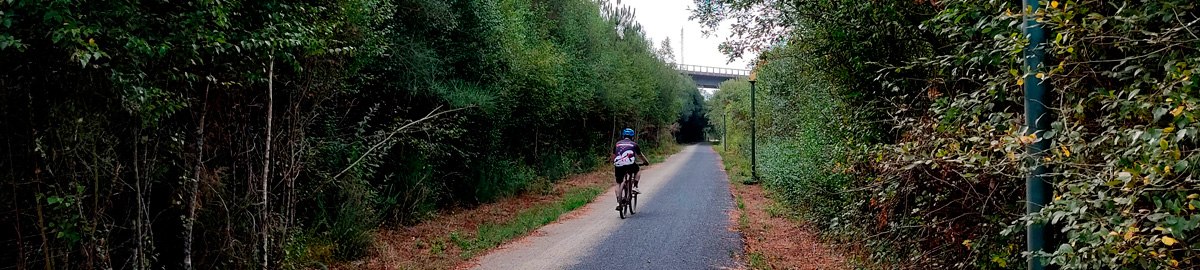
.jpg) From here, the greenway plunges into a lush, magical Atlantic forest, where oaks, chestnuts, and alders escort us along a winding route that follows the curves of the old railway line and runs parallel to the Lengüelle River, creating the perfect setting for active tourism adventures. Several local companies organise exciting kayak and canoe descents, allowing visitors to navigate its calm, crystal-clear waters while immersing themselves in the heart of Galicia's verdant Atlantic forest. These activities are ideal for families or groups, combining sport, fun, and the opportunity to admire the riverside flora and fauna from a unique and refreshing perspective. In the practical information section of this travel guide, you can find the companies offering these active tourism services.
From here, the greenway plunges into a lush, magical Atlantic forest, where oaks, chestnuts, and alders escort us along a winding route that follows the curves of the old railway line and runs parallel to the Lengüelle River, creating the perfect setting for active tourism adventures. Several local companies organise exciting kayak and canoe descents, allowing visitors to navigate its calm, crystal-clear waters while immersing themselves in the heart of Galicia's verdant Atlantic forest. These activities are ideal for families or groups, combining sport, fun, and the opportunity to admire the riverside flora and fauna from a unique and refreshing perspective. In the practical information section of this travel guide, you can find the companies offering these active tourism services.
Continuing along the route, just past km 15 we come upon the building of the former Garga–Trasmonte railway station, which features a rest area — the third we’ll encounter — ideal for stopping to eat or drink while enjoying the beauty of the surroundings and the gentle murmur of the water.
The experience of these first 5 kilometres peaks as we enter the cool, enveloping Túnel da Costa, a 207-metre tunnel. This is one of the greenway’s most distinctive attractions, offering a dimly lit passageway that takes us into the heart of the hillside and reminds us that we are travelling along the former railway platform. (Don’t forget to bring a torch or bike lights!)
In Galician lands of old Basque-style railway buildings
As we enter the municipality of Ordes, the Atlantic woodland begins to give way to a more open landscape, offering views of broad meadows and peaceful farmland. The heart of this section is the historic Ordes–A Pontraga station at km 20, now transformed into an outdoor leisure area, although its original building has not yet been restored. An interesting fact about this station is that its passenger building is an identical twin to the station at Azpeitia, on the Urola Greenway in the Basque province of Gipuzkoa, where it now serves as the headquarters of the Basque Railway Museum.
.jpg) Once in the Ordes area, it might be a good opportunity to visit the town itself, marked by traditional rural stone architecture and religious heritage. The Church of Santa María de Ordes stands out as one of its architectural jewels, combining Romanesque elements with later additions that give it its current appearance, including a characteristic façade often crowned by a robust bell gable. Beyond the church, the municipality’s architecture features rectory houses, traditional stone dwellings, and more modern landmarks such as the Museo do Traxe (Costume Museum). This rich heritage is complemented by the unmissable Galician cuisine, where local produce and traditional cooking invite travellers to recharge and savour the authentic flavours of inland Galicia.
Once in the Ordes area, it might be a good opportunity to visit the town itself, marked by traditional rural stone architecture and religious heritage. The Church of Santa María de Ordes stands out as one of its architectural jewels, combining Romanesque elements with later additions that give it its current appearance, including a characteristic façade often crowned by a robust bell gable. Beyond the church, the municipality’s architecture features rectory houses, traditional stone dwellings, and more modern landmarks such as the Museo do Traxe (Costume Museum). This rich heritage is complemented by the unmissable Galician cuisine, where local produce and traditional cooking invite travellers to recharge and savour the authentic flavours of inland Galicia.
After this cultural and gastronomic pause, we return to the cycling and/or walking itinerary. A new rest area, Ordes–A Ponte, awaits at km 21.5 — a designated spot for motorhomes.
We continue uphill, passing works of engineering that reveal the significant effort required to build the railway: we cross level crossings and imposing cuttings where the train once sliced through the rock. On this gentle ascent, the route leads us into the municipality of Tordoia (km 24), where we reach one of the highest points of the entire route. One of the rewards here is the sweeping panoramic views of the landscape — a prelude to our approach to the Gorgullos–Tordoia halt.
This stretch is the perfect transition between monumental engineering and the stillness of rural Galicia — a quietness that invites you to briefly detour from the path to discover other natural treasures. Very close to the route lies the impressive Fervenza de Santaia or Fervenza de Portociños (also known as Salto do Lobo). This magnificent natural st is shaped by the Viladabade River, a tributary of the Lengüelle, and also hides a fascinating ethnographic heritage with several old water mills, one of which (the Acea de Estevo) still preserves its machinery in working order.
We resume our journey along the greenway, and once past the rural landscape of Tordoia, the route shifts direction: from km 30 onwards, the itinerary leaves the original railway line that once linked Santiago and A Coruña (today used by the high-speed AVE line to Galicia). Until we reach the municipality of Cerceda, we follow alternative paths — no less beautiful for it. Along the way, another rest area at the former Queixas–Londoño station welcomes us, proudly displaying an iconic example of railway architecture. The bright blue colour of its façade once again recalls the aesthetic of the railway stations of Euskadi (the Basque Country).
.jpg) After another 2 km, the greenway splits into two branches before reaching the end of the route at km 36. Now on Cerceda land, our journey culminates at the emblematic former Cerceda station, today restored as a tourist hostel. This 19th-century building, renovated in 2023, features three themed rooms with railway-inspired names (O Ánden, As Vías and O Vagón) as a nod to its railway past. It also offers bike rental services, a café, restaurant and a garden terrace where visitors can enjoy the surroundings and, of course, the greenway itself, along with the large water tower that's still preserved and other historic railway elements. In barely two years, this place has become a meeting point and leisure space for locals and visitors alike, a symbol honouring the railway's history, ready to welcome all who travel the Compostela–Tambre–Lengüelle Greenway.
After another 2 km, the greenway splits into two branches before reaching the end of the route at km 36. Now on Cerceda land, our journey culminates at the emblematic former Cerceda station, today restored as a tourist hostel. This 19th-century building, renovated in 2023, features three themed rooms with railway-inspired names (O Ánden, As Vías and O Vagón) as a nod to its railway past. It also offers bike rental services, a café, restaurant and a garden terrace where visitors can enjoy the surroundings and, of course, the greenway itself, along with the large water tower that's still preserved and other historic railway elements. In barely two years, this place has become a meeting point and leisure space for locals and visitors alike, a symbol honouring the railway's history, ready to welcome all who travel the Compostela–Tambre–Lengüelle Greenway.
But Cerceda’s tourism offer goes far beyond the greenway. The municipality is known throughout Galicia as a destination for leisure and nature. In summer, the Cerceda Aquapark — the region’s only water park — attracts thousands of visitors with its pools and slides. Additionally, the Lago das Encrobas (or Lago de Meirama) is a must-see: the result of the environmental restoration of an old lignite mine, it is now a privileged and protected natural space, ideal for hiking and birdwatching, with a 6.5-km perimeter trail. You can also visit several museums, such as the Cerceda Ecomuseum or the Moucho Museum (dedicated to owls), which showcase the landscape, industrial heritage and history of this corner of A Coruña, making it an especially intriguing place for children.
And there you have it, we reach the end of the Compostela–Tambre–Lengüelle Greenway: an irresistible getaway that immerses travellers in history, engineering, local culture and, of course, the lush green nature of the Galician inland.