
Do Salnés Greenway
Route Description
It is only 9 km, but it is concentrated. We will set off with views of the Arousa estuary and arrive at an old station that owed its existence to the loss of colonial power and the boom in domestic sugar production. Along the way, we will see oak and pine forests, centuries-old eucalyptus trees, a garden of international excellence, Albariño vineyards and an iron bridge that will take us back to the days when the English ruled, and ruled with an iron fist, over the railways of Galicia; a bridge that spans the Umia River, which irrigates one of the most fertile plains in this region.
The route
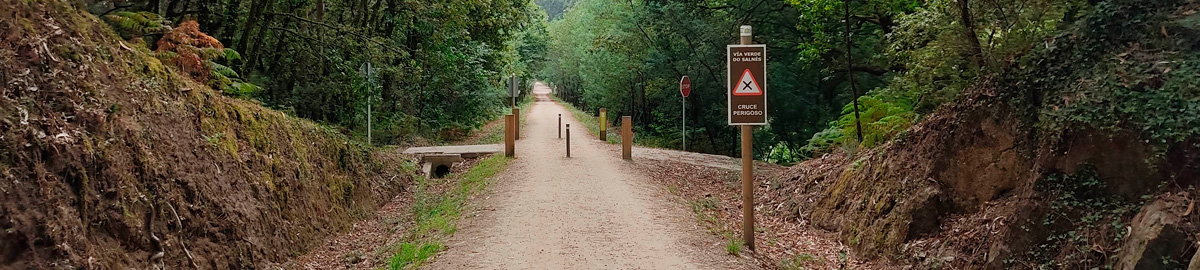
.jpg) The do Salnés Greenway, opened in 2020, runs entirely through Galician territory. This was one of the first railway routes in the region: the line that linked Carril — the terminus of Galicia’s very first railway (Santiago–Carril) — with Pontevedra, the provincial capital, in 1899. The route passes through the municipalities of Vilagarcía de Arousa, Caldas de Reis and Portas. Stretching just over 9 km, it features three rest areas, two viewpoints and a metal bridge which itself serves as a superb lookout over the Umia River.
The do Salnés Greenway, opened in 2020, runs entirely through Galician territory. This was one of the first railway routes in the region: the line that linked Carril — the terminus of Galicia’s very first railway (Santiago–Carril) — with Pontevedra, the provincial capital, in 1899. The route passes through the municipalities of Vilagarcía de Arousa, Caldas de Reis and Portas. Stretching just over 9 km, it features three rest areas, two viewpoints and a metal bridge which itself serves as a superb lookout over the Umia River.
The greenway begins in the hamlet of Abelle (km 0), on the outskirts of Vilagarcía. Access is signposted whether we’re heading towards Pontevedra or Caldas. We can reach it on foot, by bike or by car. Once we climb up to the former railway level, the higher ground offers a sweeping view of Vilagarcía and its estuary — a true feast for the eyes. Right here at the starting point we’ll find the first rest area along the greenway, as well as an information panel with an overview map welcoming travellers. Ready to go? Let’s begin.
A land of mimosas
Right from the very first few steps, we'll discover just how resourcefully every inch of land is used in Galicia: tall vine trellises growing alongside vegetable patches for the chickens that live in a corner of the plot, fruit trees, the occasional hórreo (traditional raised granary), stone barbecues… As the cluster of houses fades behind you, an avenue of mimosas (acacias albeatas) leads us towards the first major landmark of the greenway: Rubiáns Manor House (Pazo de Rubiáns). This is a true architectural gem from the 18th century, built upon a 15th-century tower. It originally belonged to the Caamaño family, the founders of Vilagarcía. Its French-style garden is without doubt one of the highlights you can visit along the greenway route. It's home to magnolias, 800 varieties of camellias, and a few eucalyptus trees, which have earned it the distinction of "Garden of International Camellia Excellence." And here's the thing, traveler— You can visit it year-round with advance booking. There is also a rest area here and an access point with parking for the greenway.
.jpg) Both the deciduous wood visible at the far end of the manor's estate and the mimosa-lined path itself show us—and prove to us—that this is a route worth visiting at any time of year: when the multicoloured leaves fall and leave the trees bare, the green acacias will begin to sprout their striking yellow fruits, a scene we'll encounter several times throughout the entire route to Portas.
Both the deciduous wood visible at the far end of the manor's estate and the mimosa-lined path itself show us—and prove to us—that this is a route worth visiting at any time of year: when the multicoloured leaves fall and leave the trees bare, the green acacias will begin to sprout their striking yellow fruits, a scene we'll encounter several times throughout the entire route to Portas.
After taking in and perhaps visiting, the pazo, its main building and annexes, its centuries-old trees, its French-style flower beds, and its thousands of camellias, the route continues along a new tree-lined avenue that will lead to the old Rubiáns halt (km 1.7), which has also been restored.
Along the way, we'll see much of the pazo's albariño vineyard on our left. Soon after, we'll encounter once again that unmistakable scene of Galician villages, where every inch of land—usually divided into tiny plots—serves a purpose, including the odd multipurpose shed of eclectic aesthetic appeal. After passing the ruins of the original and extremely modest Rubiáns halt, almost beneath the northern ring-road bridge of Vilagarcía, we enter the lands of Caldas. To mark the transition, there is another rest area here, complete with helpful information panels. It is in this municipality, in Caldas de Reis, where the greenway connects with the Portuguese Way to Santiago.
The murmur of water
In roughly two kilometers, we'll cross a stream, the first of several on the way to Portas. At all of them, we’ll enjoy the murmur of water, along with the sound of tree branches swaying in the breeze. There's no shortage of reed beds either, or the unmistakable riverside vegetation: white willows, ash, alders, chestnuts, oaks, laurels... Flora we'll see again and again throughout the entire route, though almost always with the mimosas in the foreground at the foot of the old railway line, and then everything else beyond, with a horizon of extensive eucalyptus and pine plantations that give this part of Galicia its characteristically "evergreen" appearance.
Halfway along the greenway, in the hamlet of Godos, we’ll spot on the left the wind turbines crowning Mount Xiabre, whose modern blades contrast with the silhouette, on the right, of the bell gable of an old church set against a backdrop of an endless sea of green hues.
A little further on, we'll reach the O Coutiño viewpoint (km 5,5), a perfect place to rest while gazing at the Umia River and learning, through another information panel, about some of its characteristics. Shortly after, we'll come upon a curious rock formation, properly signposted: the Pedra de Rañacús (km 6).
Final stop
.jpg) The path then leads us to the bridge over the Umia River (64 m). Built in 1897, it's an iron structure resting on two massive granite stone bases. Just before reaching it, there's a detour to the left that, in barely 50 meters, takes us down to the river. It's well worth it, not only because we'll be standing on the riverbed, but because we’ll be able to see the metal structure in all its length and appreciate human ingenuity in bridging the gap between the two banks to allow the train to pass. What's more, on the left, there's a beautiful trail that, if we follow it—walking along the banks of the Umia for about 5 km—will take us to the spa town of Caldas de Reis.
The path then leads us to the bridge over the Umia River (64 m). Built in 1897, it's an iron structure resting on two massive granite stone bases. Just before reaching it, there's a detour to the left that, in barely 50 meters, takes us down to the river. It's well worth it, not only because we'll be standing on the riverbed, but because we’ll be able to see the metal structure in all its length and appreciate human ingenuity in bridging the gap between the two banks to allow the train to pass. What's more, on the left, there's a beautiful trail that, if we follow it—walking along the banks of the Umia for about 5 km—will take us to the spa town of Caldas de Reis.
Back on the bridge and the greenway, we take on the final stretch of our route, not without first enjoying the river once again, this time from above, and the views of another small hamlet, aptly named Paraíso (“Paradise”, as the place name indicates). Resuming our walk, the mimosas shelter us once again along the path, and the end of the greenway becomes clear as the rooftops of a few houses come into view — along with the vine trellises and power lines…
We now reach our final rest area, near Mount Agoseite (km 8). From here, along a paved path, we'll soon spot the remains of the sugar factory, whose imposing chimney signals that we're just steps away from reaching our destination: the old Portas station (km 9,2).
Before arriving, it's worth noting that this former Portas sugar factory is one of the finest examples of early 20th-century industrial heritage in Galicia. It stands as a reminder that when Spain lost its last colonies in 1898, one consequence was that sugar shipments from Cuba ceased to arrive, prompting the construction of sugar factories across Spain—this one in Portas being among them. Today, the factory's 65-metre-high chimney has been transformed into a spectacular viewpoint over the Salnés valley, and the building itself, now restored, serves various public purposes: a nursery school, play centre, senior citizens' centre, exhibition hall, and conference space.
A sweet ending to this route.